
I have always had an interest in learning, it creates a spark in me when I discover possibilities and my world gets a little bigger in the process. I often felt almost envious of people who could see the whole picture I hadn’t reached yet, but I’ll get there too!
This passion for learning led me to ask: how does one actually learn well? The standard tips didn’t always land, and I think that’s because not all learning is the same. What I’ve come to think is that much of it comes down to two things: how fast the environment gives you feedback, and how deterministic the domain actually is.
Feedback is the mechanism that makes learning work at all. Without it you’re not practicing, you’re just repeating. It’s how you catch mistakes, correct your model of the world, and gradually close the gap between where you are and where you’re trying to get. The speed, frequency, and cost of feedback in whatever you are learning matters a lot for your practice.
The second variable is how deterministic the domain is. Some things behave consistently, the same input reliably produces the same output, and experts tend to agree on best approaches. Other domains are genuinely complex: context-dependent, non-linear, shaped by relationships and timing. What worked last year might not work today. Expertise in these domains looks different, and learning has to work differently too.
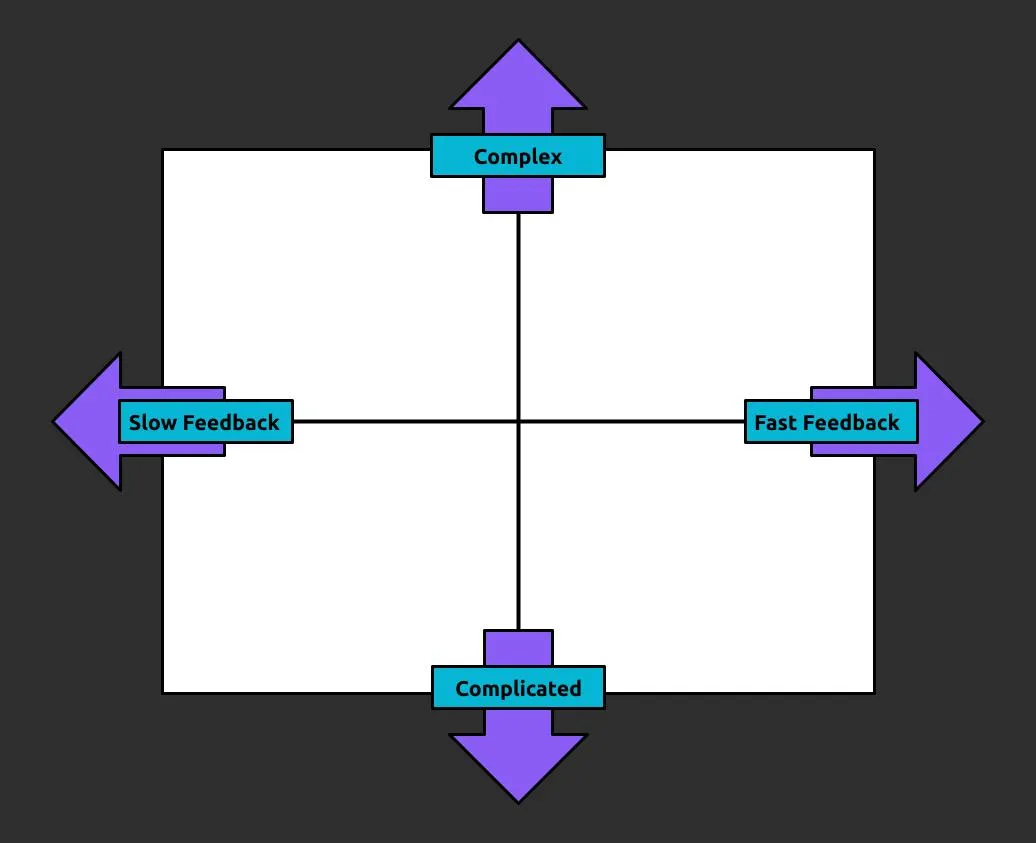
Those two axes give you four distinct learning environments, each of which requires a different approach. Fast feedback in a deterministic domain is one thing. Slow feedback in a complex one is something else entirely. The four combinations aren’t just variations on the same problem. They call for different tools, different mindsets, and in some cases different definitions of what progress even looks like. 1
This post is the start of a series where I dive into each of the quadrants in the model to see what they are all about and also bringing forth some tactics to navigate learning in each of them.
Footnotes
-
After developing this model independently through systems theory, I discovered parallels with Dave Snowden’s Cynefin framework. Convergence from different directions felt worth noting. ↩


