Every now and then you come across an idea that puts familiar things in a new light. Not because you suddenly become convinced it’s true, but because it reveals a different way of organizing your thinking. I’ve had a few experiences like that this year while exploring theories of consciousness. Whatever one thinks of perspectives like idealism or panpsychism, they all share a willingness to question assumptions that usually go unnoticed, sometimes by asking us to reverse them entirely.
I’m glad I happened to stumble across Big Magic by Elizabeth Gilbert. It made me realize that the same kind of inversion I’d been thinking about in consciousness could also be applied to creativity.
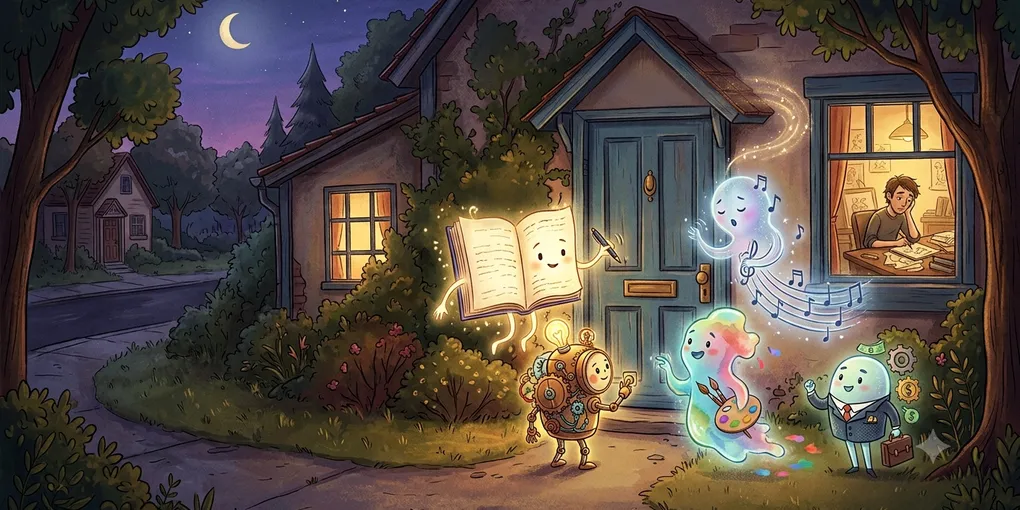
The book is warm and encouraging throughout, but what really stuck with me is Gilbert’s perspective on ideas. Gilbert asks us to entertain an unusual possibility: what if ideas are not something we produce, but something we encounter? In her view, ideas exist independently of us. They want to become real, but they need a human collaborator to bring them into the world.
What fascinated me was not only the idea itself, but the inversion it represents. We usually think of people producing ideas. Gilbert asks us to imagine the opposite: that ideas are looking for someone willing to collaborate with them.
It’s a perspective she returns to throughout the book, perhaps best captured in one line that stayed with me:
“The work wants to be made, and it wants to be made (if you let it) through you.”
Whether or not you accept the premise is almost beside the point. What fascinated me was the shape of the idea. It performs the same kind of conceptual inversion that first drew me into those theories of consciousness. We usually ask how people create ideas. Gilbert asks us to imagine the opposite: how ideas might find people willing to bring them into the world.
If you adopt that perspective, creativity begins to resemble a relationship more than a process of production. Ideas don’t simply arrive; they also require something of you. They ask for attention, commitment, and a willingness to keep showing up. Ignore them for long enough and, in Gilbert’s telling, they move on in search of someone else.
If ideas can unexpectedly enter you, perhaps they can unexpectedly leave as well.
Viewing creativity this way also changes our sense of ownership. The finished work never feels entirely “mine.” I participated in bringing it into the world, but I wasn’t its sole origin.
At least for me, that shifts where the pressure sits. Success or failure no longer feels like a verdict on my ability to create. Instead of expecting myself to generate something from nothing, I’m simply trying to be a good collaborator.
Whether Gilbert’s perspective is literally true is probably less important than the relationship it encourages us to have with our ideas. If ideas can unexpectedly find us, perhaps our job isn’t to chase them, but to become someone they would want to return to.